Cốc Cốc | Edumina
Master IELTS with Edumina, your AI-powered study platform designed to fast-track you to your target score 🎯
Product Design, Interaction Design, Product Thinking, Design System
Discipline
Timeline
Oct 2025 - present
Deliverables
Role
UI/UX Designer
User Interface
Tools
Figma
Background Story
Me and my colleagues went out for late night snacks one day and saw a couple of middle schoolers just finished eating and about to leave.
Curiosity killed the cat 🐈 - We began to spectate how the kids paying for their food and here how it went:
Kid snap the owner’s QR code ➡️ Kid sent to parents ➡️ Kid called parents notifying them about the QR code ➡️ Parents opened banking app + scan QR code + paid the bill ➡️ Parents screenshotted transaction success screen and sent to kid ➡️ Kid show the owner ➡️ Everyone is HAPPY (or are they?)

Then we thought: “Why don’t we have a banking app tailored for kids?” 🤔 Crazy - Well, actually, it’s the beginning of Abby Family
So, what exactly is the problem?
139
moms
& dads
+
80
kids
We knew that the relationship between parents and kids in the context of finance is arduous. Thus, we did comprehensive research to make sure we identify the patterns and expectation on finance from both parties.
6
competitor
analysis

👦🏻 Kids:
👩🏻 Parents:
Don’t get educated on how money works at an early age
Have to ask for cash every single time they need to spend on something either minor or urgent
Struggle with keeping track of the kids’ request for money and their spending
Lack confidence in fostering financial awareness in children.
Deeper insights on the parents’ perspective
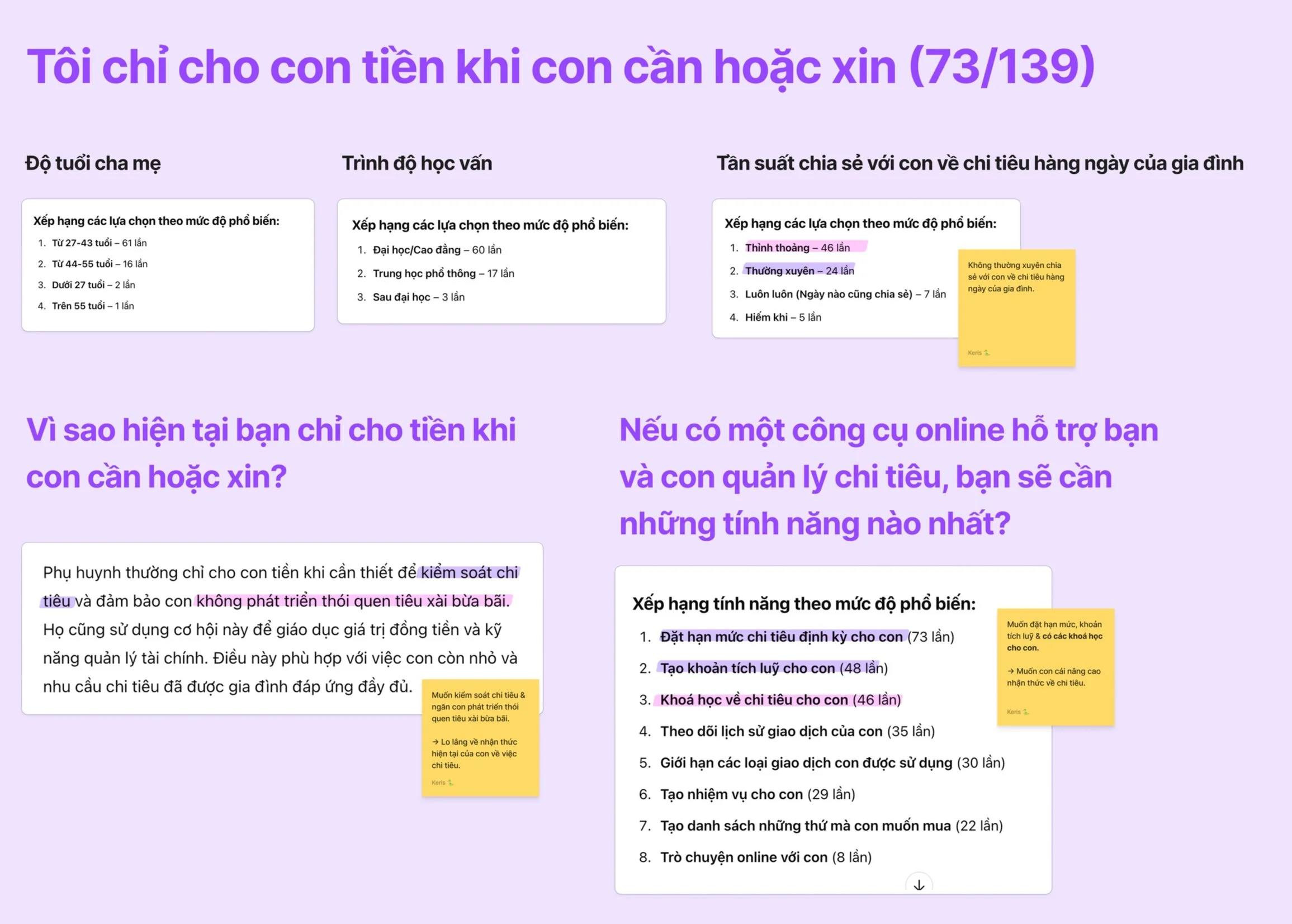

They aim to prevent bad spending habits and use it as a chance to teach financial values.
They prefer tools that allow setting spending limits, savings goals, and teaching financial literacy.
Parents who give money regularly prioritize habit-building and real-life learning
They are more open to sharing family spending and often guide through hands-on experience.
Their main needs are tools to track spending, set goals, and limit usage by category.
Financial transparency is low in both groups, but better among regular givers
Most parents in both groups only sometimes talk to kids about daily expenses.
Regular-giving parents are more likely to share and explain, indicating a more collaborative mindset.
Both groups want digital tools—but with different priorities
“Only when needed” parents want control-oriented features (limits, restrictions).
“Regular givers” want tracking and co-learning features (task assignments, history logs).
01
02
03
04
Parents who give money only when asked focus on control and discipline
Moreover, what does literature play a part in our research?

Value Proposition


